Biker Delivery vs. Traditional Courier in India
The Ultimate Guide to Speed, Cost, and Use Cases
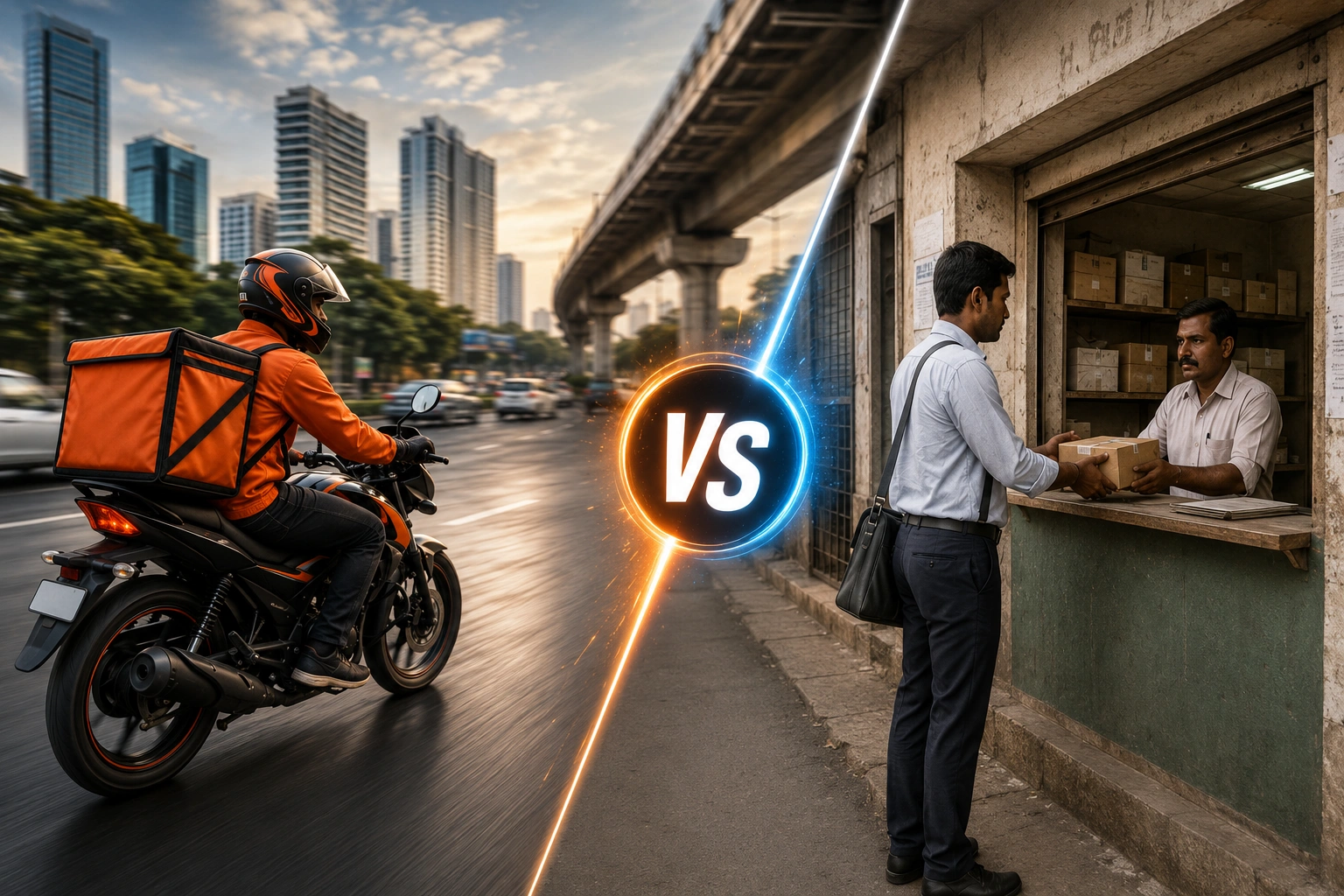
The final mile of logistics across Indian cities has undergone a complete structural transformation. Moving away from standard, multi-day shipping windows, the modern commercial ecosystem operates on instant accessibility, driven by the rapid expansion of direct-to-consumer (D2C) brands, quick commerce, and omnichannel corporate fulfillment networks.
For retail managers, enterprise operations directors, and everyday consumers, choosing how to transport an item across a crowded urban area requires balancing operational speed against cost efficiency.
The core logistical choice frequently comes down to a clear operational divide: biker delivery services in India versus traditional hub-and-spoke courier networks. While traditional couriers remain essential for cross-country bulk transport, the nimble two-wheeler has become a vital asset for navigating urban traffic.
This in-depth guide provides a direct analysis of both delivery methods across speed parameters, cost efficiency, volumetric limits, and real-world business use cases in India.
The Macro View: The Last-Mile and Hyperlocal Landscape
To understand why the battle for the final mile has intensified, it is helpful to look at current market data. According to a comprehensive market analysis, India's last mile delivery market size reached USD 7.4 billion in 2025 and is projected to expand to USD 24.5 billion by 2034, growing at a compounding annual growth rate (CAGR) of 13.54%.
Concurrently, research indicates that the domestic last-mile sector is set to generate over USD 8,963.3 million in revenue, showing a clear upward trend in high-frequency, local shipments.
India Last-Mile Delivery Market Expansion (USD Billion)
- 2025:7.40
- 2026:7.96 (Est.)
- 2034:24.50 (Proj.)
This massive growth is closely tied to the rise of hyperlocal delivery in India. Market data highlights that the domestic hyperlocal ecosystem is projected to reach USD 14.6 billion by 2033, expanding at a 12.72% CAGR.
Additionally, India's quick commerce sector is on track to cross USD 9 billion in Gross Merchandise Value (GMV), driven by a rapid build-out of localized dark stores, which grew to over 3,500 facilities nationwide. This decentralized warehouse model relies almost entirely on an agile network of two-wheelers to complete fast, short-range deliveries.
Structural Breakdown: Biker Delivery vs. Traditional Courier
To choose the right shipping method for your business, it is essential to understand the underlying infrastructure differences between these two logistics models.
Biker Delivery Logistics
Point-to-Point Agile Transport
Biker delivery networks bypass standard consolidated shipping infrastructure. When an order is placed, a dedicated operator collects the package directly from a localized merchant, micro-fulfillment center (MFC), or private office, and transports it straight to the recipient's doorstep. There are no intermediate sorting facilities, overnight storage delays, or complex unloading routines. The delivery timeline is limited only by the driver's ability to navigate local traffic patterns.
Traditional Courier Logistics
Hub-and-Spoke Consolidated Transport
Traditional couriers rely on a structured, multi-tiered sorting network designed for volume efficiency. Packages are collected via regional vans, brought to a local consolidation branch, moved to a central hub for sorting, sent across long-haul highway or rail networks, and then assigned to local delivery drivers for morning routes. This model offers exceptional cost savings for bulk shipments but introduces multiple hand-offs and structural wait times that make it poorly suited for same-day delivery.
Face-to-Face Comparison: Speed, Cost, and Capacity
Evaluating the efficiency of last-mile operations requires looking closely at three primary performance variables.
Velocity and Transit Dynamics
- Biker Delivery: Operates on an on-demand schedule, with delivery windows ranging from 10 minutes to 3 hours within a radius 15-20 kilometers. Two-wheelers easily filter through urban traffic bottlenecks in high-density areas like Mumbai, Bengaluru, and Delhi-NCR, maintaining reliable delivery schedules even during peak congestion.
- Traditional Courier: Typically runs on next-day, 48-hour, or multi-day schedules. Delivery timelines are bound to fixed sorting routines and delivery vehicle schedules, making it difficult to adapt to sudden, time-sensitive requests.
Cost Structures and Unit Economics
- Biker Delivery: Uses a dynamic, transactional pricing model based on distance traveled, weather conditions, and immediate market demand. While the per-kilometer cost for single items can be higher, it eliminates the need for expensive secondary packaging and sorting fees, offering excellent value for rapid, local deliveries.
- Traditional Courier: Features an economical pricing model scaled for volume, calculated primarily by weight or volumetric dimensions. For shipping multiple parcels over long distances, consolidated shipping provides unmatched per-unit savings.
Volume, Weight, and Payload Constraints
- Biker Delivery: Restricted by the physical carrying capacity of a standard two-wheeler, typically capping out around 20 to 25 kilograms and fitting within standard rear-mounted thermal bags or secure backpacks.
- Traditional Courier: Features virtually unlimited capacity, utilizing extensive fleets of small commercial vehicles (SCVs), medium duty trucks, and long-haul containers capable of moving heavy freight and bulk pallets smoothly.
Detailed Performance Comparison
| Delivery Model | On-Demand Biker Delivery Networks | Traditional Hub-and-Spoke Couriers |
|---|---|---|
| Primary Speed Window | 10 minutes to 3 hours (Immediate) | 24 to 72+ hours (Scheduled) |
| Transit Framework | Direct point-to-point path | Multi-stage consolidation hubs |
| Traffic Agility | High; easily filters through gridlock | Low; affected by urban truck restrictions |
| Pricing Base | Distance-based & real-time demand | Weight, dimensions, and zone-based |
| Payload Envelope | Limited (≤ 25 kg per ride) | High (Grams to multiple metric tons) |
| Tracking Precision | Real-time GPS location streams | Milestone-based scan updates |
| Packaging Mandate | Minimal; standard retail boxes | High; requires rugged corrugated casing |
| Proof of Delivery | Instant electronic signature/photo OTP | Physical signature or end-of-day log |
Industry-Specific Use Cases: Strategic Deployment
Different business verticals deploy these last-mile strategies based on their unique product constraints, customer expectations, and operational demands:
1. Direct-to-Consumer (D2C) & Omnichannel Retail
Modern e-retail consumers view fast delivery as a baseline expectation.
The Strategy: High-growth fashion, beauty, and premium electronics brands use a hybrid fulfillment model. They utilize traditional shipping to move bulk inventory from central manufacturing hubs to local dark stores across major cities. From there, they activate a last mile biker delivery network to complete local customer orders within hours, balancing bulk transport savings with responsive local service.
2. Banking, Financial Services, and Insurance (BFSI)
The banking and financial sectors regularly handle sensitive, high-value physical assets that require secure, verifiable transit.
The Strategy: Corporate offices rely on a dedicated two wheeler delivery model to move original loan agreements, new credit/debit/forex cards, cross-border bank guarantees, security tokens, and corporate checkbooks between commercial branches and executive offices. This point-to-point transit model reduces custody touchpoints, lowering the risk of document loss compared to large-scale sorting hubs.
3. Medical, Biotech, and Specialized Pharmacies
Healthcare and local pharmacy networks handle temperature-sensitive, time-critical materials that directly impact patient care.
The Strategy: Localized pharmacies, diagnostic labs, and clinical networks utilize a dedicated bike network to move urgent prescriptions, patient blood samples, and specialized medical instruments between collection centers and testing labs. The speed of on-demand transit helps preserve sample viability without requiring expensive, heavy refrigerated packaging.
Technological Enablers Reshaping Two-Wheeler Logistics
The growth of two-wheeler distribution networks is heavily driven by advanced software and vehicle technology.
- AI-Driven Route Optimization: Modern fleet platforms deploy machine-learning routing engines that analyze local traffic patterns, historical drop-off times, and real-time weather data. These systems help drivers bypass congested routes, yielding significant fuel savings and raising on-time performance levels.
- The Transition to Electric Fleets: Faced with rising fuel costs and strict corporate carbon reduction targets, the logistics sector is rapidly adopting Electric Two-Wheelers (E2Ws). Fleet electrification converts variable fuel expenses into predictable, lower charging costs, making high-frequency urban shipping more economically sustainable.
- Geofencing and Automated Dispatch: Advanced location intelligence platforms automatically match new orders with the nearest available rider based on precise geofenced boundaries. This automated matching minimizes wait times at pickup points and ensures quick dispatch.
Choosing an Infrastructure-Backed Fleet Partner
Managing a large internal delivery fleet requires significant capital, time, and administrative effort spent on rider retention, vehicle upkeep, and route tracking. For growing startups and scaled enterprises alike, partnering with a professional third-party provider is often the most efficient path to scaling local fulfillment.
If you are looking to optimize your local fulfillment strategy, choosing an infrastructure-backed network is key. SRS Combined Cargo offers India's most trusted and flexible two wheeler delivery service with guaranteed on-time deliveries across major cities. Our professional bike courier network in India ensures your packages reach their destination swiftly and securely.
By offloading last-mile management to an experienced corporate partner, businesses can quickly expand their delivery reach, navigate seasonal demand spikes, and maintain excellent service standards without the burden of managing a private fleet.
Conclusion: Designing a Balanced Logistics Framework
The choice between biker delivery and traditional couriers is not an either-or proposition. Instead, a resilient supply chain strategy uses both models in a complementary fashion based on distance, urgency, and package size.
Traditional hub-and-spoke couriers remain highly efficient for moving bulk inventory across state lines and handling heavy freight over long distances. However, for navigating congested urban environments, meeting tight delivery windows, and providing seamless point-to-point tracking, professional biker delivery service in India is an essential tool for modern enterprise logistics.
By working with an established logistics specialist like SRS Combined Cargo Pvt. Ltd., your business can instantly deploy a balanced, nationwide network capable of handling bulk freight transfers and rapid, local last-mile deliveries with equal efficiency.
Related Topics
For a broader understanding of logistics operations in India, including warehousing, freight forwarding, and supply chain management, see our complete logistics and supply chain guide.
Explore Other Blogs & Guides:
Our Logistics Services in India
SRS Combined Cargo offers end-to-end logistics solutions across India: